As 2011 Approaches The Future For The Health Club Business Is Promising

This is an excerpt from an upcoming article written by Bryan K. O'Rourke, MBA, that will be featured in the Gold's Gym Franchisee Association's digital magazine "The Voice".

As we enter 2011, the health club business, like many, faces tough times.  Slow growth stands in contrast to a history of expansion.  However, short term problems might ultimately serve to separate the capable from the unprepared. By adopting new business models and technologies, smart competitors will flourish while others struggle to survive.  As economic conditions improve, the strategic minded club operator will be positioned to do very well and have the chance to wrestle away market share while potentially growing the industry overall. How will a promising future unfold in light of recent struggles?  Here are some thoughts.

Economic Outlook Is Slowly Improving

Economic conditions are improving, albeit slowly. According to the November IHS Global Insight Economic Outlook Index, real GDP growth is forecasted at 2.2% in December through March of 2011, with 5 of 11 leading indicators being positive. While lending remains tight, funds are available for good credit risks. Despite slowly improving near term economic conditions, more important long term transformative factors are impacting the health club business along with other industries as technological advancements, changing consumers and new economic models create challenges and new opportunities.

New Business Models

Larger “budget club” formats like Equinox’s newly developed “Blink”, among others, reflect a further evolution of business models, offering monthly membership dues of as little as $10. Meanwhile new, hi-end, experiential and niche facilities such as Lifetime’s Lifepoweryoga, Soul Cycle, and Fitness Euphoria offer memberships for $80 or more per month with the option to pay for single sessions starting at $20. These more experiential facilities offer higher levels of membership engagement at a higher price point. Bottom line is these and other new models are generating positive ROI's and reflect evolving concepts and formats that will drive growth for the health club industry.

Technology

The bricks and mortar fitness industry is changing. Internet ubiquity, mobility and social platforms are changing the way business is and will be done in and outside of the four walls. The potential for engaging members and prospects using these technologies is unlimited. Solutions, like SCVNGR, Foursquare and others are already being used for marketing and brands like Gold’s, Equinox and others have launched sophisticated applications for their members. With online services and memberships growing, this is only the beginning of what is to come, as intelligent operators will use these technologies to interact with and service their existing and prospective members in new and exciting ways.

Wellness

While the popularity of fitness has increased substantially during the past several decades, the idea of illness prevention is a concept that national health policy can no longer ignore. With national health care costs topping $2.7 trillion in 2010, the health club industry by comparison represents less than a penny on each dollar spent on illness. This despite wide ranging research showing the benefits of exercise and diet in preventing most major chronic illnesses.

New monitoring technologies and health club services and programs offer an answer to the health care crisis. As health care costs become untenable, employers and the government are seeking prevention solutions. In a recent ground breaking decision Medicare began reimbursements for Pritikin’s intensive diet and exercise programs for qualifying individuals with a history or risk of cardiovascular events. Employers are also embracing wellness programs as a means to cap their exploding health care costs as well. This is a big business opportunity for health clubs.

Art Curtis, Chairman of IHRSA, recently called on the leaders of the health club industry to launch a comprehensive campaign that will improve our nation's health through positive personal behaviors and working closely with important stakeholders like government agencies, educators, the medical community and others. Art is right and many health club players will intelligently enter the prevention business in the years to come.

What Do You Think ?

Contact me, Bryan K. O'Rourke, and tell me "do you think the future for health clubs is promising?" Why or why not ? Read my upcoming article in the GGFA's "The Voice" to learn more on key trends around the future of the health club industry.

Interested in the Future of the Health Club Industry ?

If you are associated with the Gold's Gym Brand, please register to attend my webinar on Wednesday, December 1, 2010 from 1:00 - 2:00 pm EST.

The health club and fitness industry are undergoing lasting and fundamental change which the economic environment is only accelerating. During this webinar I'll explain what it means and why. Thanks to the GGFA for allowing me the chance to contribute.

Do you think the health club industry is going through fundamental change ? Please contact me, Bryan O'Rourke, and tell me what you think and why.

Why Do So Many Fitness Industry Suppliers Still Try to Sell Like Its 1975 ?

I serve fitness professionals and their organizations. Our company fitmarc is one of the leading suppliers of programs, education and consulting in the U.S.. We have a great team and Robert Dyer is a great partner. Our featured products include Les Mills fitness formulas  and we serve as the exclusive south central distributor in the U.S. Fitmarc and its affiliate integerus, however, do a lot more than that. Hopefully we will be doing a lot more with some pretty well known brands soon. What we don't do is try to shove things people don't want down their throats, and therein lies the purpose for this post.

I've been working with some "leading" vendors in the fitness and wellness space as well. These are prominent names in the business. What surprises me is how so many of these organizations continue to "Sell" - many approaching the business like firms of decades ago. Push, push, push. They are unaware of "Sales 2.0" and engage in lots of telemarketing and pushing - But Why ?

Is the fitness industry just behind the times ? Cold Calling doesn't work anymore ! So why do so many fitness suppliers still pursue it ? Jeff Gitomer, one of my favorites, shares his insights regarding the new world of business development in the video below - let me know what you think. I must give a shout out to my colleague and sales guru Sal Pellegrino - who turned me on to Gitomer as well as his comrade in crime Larry Domingo - now both with the Star Trac brand. Kudos guys - you are both special and I appreciate all you've shared.

Contact me, Bryan O'Rourke, and let me know what you think. Are you as a fitness professional tired of being "Sold" or "Cold Called" by suppliers or "wannabes" ? Why do you think as an industry many vendors continue to approach the market this way ? Please share your thoughts.

Global Obesity - Are Fitness & Wellness Leaders Mindsets Part Of The Problem ?

I was watching the video below of Sir Ken Robinson's talk on changing education paradigms. It led me to draw some parallels between his views on needed changes in thinking around a broken approach to education and a similar situation regarding wellness and fitness. If you read my posts before, you know I like to write about the future and its promise. I believe the fitness and wellness industries must play an important role in that future. You see we increasingly hear of crises we face every day as nations and as humans. There is the  recent economic crisis and the growing climate crises. We also know we face a global health crisis and it isn't getting better; despite all of the growth of the fitness and wellness business our world is getting less well. The World Health Organization predicts there will be 2.3 billion overweight adults in the world by 2015 and more than 700 million of them will be obese. Something, therefore, isn't working and this is what Robinson's video alludes to in general about education. The problem is fundamental: but why ?

The cost of providing health care now and increasingly in the future is bankrupting our economies; this is irrefutable and the rise of the global poor is only exacerbating the situation as obesity rears its head across the world. I won't even touch upon the diminished quality of life factors and impact on productivity.

This is a dilemma. We all want progress but we must acknowledge the consequences this progress creates. Interestingly the origins of all of these significant crises are the same. These challenges go unsolved because of their source. To change requires doing things differently; to innovate fundamentally; to change how we educate, manufacture, govern, and in the case of the fitness and wellness industry, help people be well. You see the way its being done now does not work - the evidence is undeniable.

Innovation is hard because it means doing something that people don't find very easy. It requires challenging what we take for granted, things that we think are obvious. The great problem for any reform is the tyranny of common sense. Things that people think, "Well, it can't be done another way because that's the way it's done." One of my favorite quotes is that of Daniel Boorstin who observed, "The greatest obstacle to discovery is not ignorance, it is the illusion of knowledge. And therefore the fundamental barriers to progress in this regard are mostly the leaders of the very institutions created to forward their initial cause. Therefore I'd ask, is our industry, fitness and wellness, part of the globesity problem ? Is our thinking getting in the way of the solutions ?

What do you think ? Is the Fitness Industry , the Wellness Industry, contributing to the global obesity problem ? Why or why not ? Contact me, Bryan O'Rourke and share your views on this please and watch the video below for perspectives on how irrelevant mind sets are THE problem for education. The parallels are obvious to me - are they to you ?

The Top 5 Mobile Location Based Applications For Your Fitness Business

Location-based mobile apps and services have been around a while, but with the explosion of smart mobile devices 2011 is going to be THE breakout year. Big retail brands are starting to experiment with location-based campaigns and checkin rewards programs and the fitness industry will eventually follow. It does not seem, however, many in traditional fitness or wellness have attempted to explore this emerging solution, yet. I believe that will change and soon.

An article by Jennifer Van Grove titled the Top 5 Location Based Services Mashable Awards published in October listed the top five location-based services in a list that includes predictable names and lesser known upstarts.

Her list below serves as a countdown beginning at the fifth most significant service and arriving at her top pick for location-based innovation. Thanks Jennifer for a great assessment and article on the topic - the full article is available here.

Has your fitness business experimented with location based applications and services ? What is working or not ? What do you think about this in the fitness or wellness space ? Contact me, Bryan O’Rourke, and share your experiences or thoughts on location based campaigns and reward programs in the fitness industry as it relates to these new platforms.

5. Yelp for Mobile

Yelp is the original location-based service that redefined “local” for small businesses and their online customers. In 2010, Yelp continues to remain relevant with mobile applications that reach BlackBerry, iPhone, Android, PalmPre, Windows Phone 7, and most other smartphone users.

Yelp Mobile may not be the trendiest location-based service, but it’s arguably the most practical. Stats from September of this year show that Yelp Mobile generated 3 million unique visitors for the month and more than 1 million people created point-to-point directions to a local business. We’re not partial, however, to Yelp’s also-ran checkin features. The startup should stick to what it does best — convenient and replete location-based business listings and reviews.

4. Neer

Newcomer Neer brings ingenious innovation around personal and private automatic location-sharing to Android device owners. The startup launched earlier this year after incubating inside Qualcomm Services Labs. Creator Ian Heidt describes Neer as occupying “the middle ground between Foursquare () and Google Latitude.” That’s a technologically sound description, but we see Neer as the most practical application of location for actual real-world scenarios — like knowing if your kids made it to school.

Neer doesn’t bother with checkins, badges or other kitschy game mechanics. The service is designed so that you know where your loved ones and friends are, and vice versa. Since users have complete control over who can see their whereabouts — in place names, not physical addresses — there’s little to worry about on the privacy front. The application is also designed with the average user in mind, meaning the user interface is both slick and uncomplicated. As the space matures, location-based services will take inspiration from Neer and evolve past the pure novelty of checkins and location-sharing.

3. Loopt

Once the location app on everyone’s lips, Loopt has lost some of its luster to more buzz-worthy incumbents. But, Loopt continues to innovate around location and just last week updated its iPhone app to include deep integration with Facebook Places.

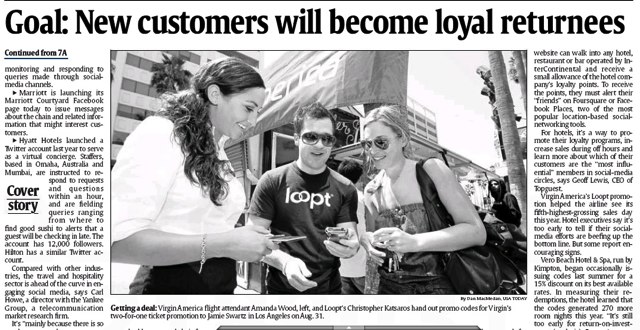
Loopt’s application is also the most aggressive of the big name players when it comes to automatic location-sharing, meaning it supports background location and proximity alerts for nearby friends. There’s also the branded-rewards Loopt Star application, which has already demonstrated that it can push users to take action and drive them to their partners’ physical locations. With this formula, there’s certainly real revenue potential beyond just advertising.

2. SCVNGR

In just a few months time, SCVNGR has gone from an obscure mobile app for iPhone and Android to a formidable player in the location space with upward of 500,000 users. Now the Google ()-backed startup is said to be making millions thanks to more than 1,000 paying enterprise clients, which include the likes of Sony and Warner Bros. As a service, SCVNGR differentiates itself with point-based challenges on top of checkins and interesting partners such as The Boston Globe, Minnesota Vikings, AT&T and the Smithsonian museums.

Just recently, the team redesigned the mobile apps to better surface user activity. Sophisticated Facebook Places integration also plays a significant role in the application experience and on the Facebook Place Pages for business owners. Perhaps more interesting than the service itself is the 21-year-old whiz kid at the helm (pictured left in the photo above). Princeton dropout and serial entrepreneur Seth Priebatsch is barely old enough to drink, but this youngster is one huge overachiever with a grandiose vision for SCVNGR and the passion to make it happen.

1. Foursquare

Despite the emergence of Facebook Places months ago, Foursquare is still very much alive with its 4 million registered users. We think it’s safe to say that this startup continues to thrive because it’s more about people and places than it is about location.

We could rattle off Foursquare’s numerous partnerships, highlight its quirky badges or talk about its battles for mayorship, but what puts Foursquare atop our list is the fact that the service has created a phenomena around checkins, badges and rewards that’s been copied and adapted by countless other web and mobile services all trying to emulate Foursquare’s magic.

Foursquare’s recent restructuring of its iPhone and Android apps to highlight tips and to-dos point to a not-so-distant future when, co-founder Dennis Crowley explained, Foursquare will “reinvent what happens after the checkin.”

In many ways, Foursquare already reinvents what happens both before and after the checkin. Just look at how Jimmy Choo employed a pair of trainers to inspire a three-week frantic offline shoe hunt in London — with shoe sales jumping 30% around the time of the campaign — as proof of the concept. It’s the one campaign that Tristan Walker, Foursquare’s director of business development, speaks most highly of, even though the startup didn’t directly participate in the sale.