The Club Business Is Improving ! Get To IHRSA 2011 !

The economy had attendance down over the past few years but 2011 is likely to break that trend. Several club operators and executives have shared with me their very good numbers for January ! A great sign for the fitness industry. So with business getting better its time to plan to get to IHRSA this March for the 30th anniversary celebration !

My colleague Kelli Hatton, who is attending this year agrees. She said, "seeing those people that can provide insight into the industry and convey their experience is why I go." In fact our entire business development team at Fitmarc will be there !

Kelli is right ! Take advantage of an improving business environment and invest in learning. There are many great speakers and super presentations. I promise that if you attend my presentation Wednesday, March 16th at 8 am on Using Technology to Improve Member Sales & Retention you will learn some pretty neat stuff ! I've included a sneak preview below you should check out !

So tell me, Bryan O'Rourke, are you planning to attend IHRSA this year ? If so why are you going or why aren't you going ? Let me know and check out this video on using foursquare for your health club that I will cover during my talk at IHRSA Wednesday morning (I'll also be presenting Saturday morning as well) and make your plans today to attend IHRSA ! Making an investment in learning will pay off huge dividends ! I'll see you there.


Exercise and Relationships - Can It Really Get That Bad ?

This morning I grabbed my IPad over tea to catch up with the WSJ. In the Living Section was this article by Kevin Helliker: A Workout Ate My Marriage. As Kevin writes, "Exercise can set off conflict about family, free time; Errands vs. English Channel.

Now being involved in fitness and wellness I wondered, is this as big of a problem as Kevin thinks ? I mean we are always talking about the fact that people don't exercise enough. How often are people exercising too much and if so can it lead to the end of a relationship ? I guess its possible and happens but how often ?

I happen to be married. My wife Maureen works out 6 times a week with a combination of ballet, weight training and cardio. I work out as well (at the same great club stone creek club and spa) and as frequently but we rarely work out together; only when we play tennis, cycle or take a BODYPUMP class. While our regime of training did not evolve until the past decade, its never posed a problem. In fact, we talk about it and enjoy doing the things we do when we do them together. So I was wondering, aren't there more couples and families who are positively impacted by training and keeping fit than negatively impacted ? Aren't these examples extreme cases ? I wondered after reading this part of the article:

The effect of extreme exercise on divorce rates isn't clear. Even if research showed a higher rate of discord in homes where just one spouse is an endurance athlete, exercise could be a consequence, rather than a cause. Among endurance athletes, though, resentment on the part of spouses is a common topic. The phenomenon may develop into what Pete Simon, an Arizona psychologist, triathlon coach and blogger, calls "Divorce by Triathlon." "I often wonder how many lonely wives, husbands, children of triathletes are out there wondering when the insanity is going to end," he wrote.

Now Kevin is a good reporter and Pete is an accomplished coach but couldn't we read more about how exercise is bringing families and couples closer together ?

What do you think ? What is your experience ? Do you know of a situation where working out broke up a marriage ? Do you think couples and families can be closer as a result of being active ? If so, please share your views with me, Bryan O'Rourke. Can working out too often make marriage and family life that bad or make it better ?

The "New" Bricks & Mortar Fitness Model Must Include Engaging Programming

This morning I woke early, to get my workout in at Stone Creek Health Club and Spa. Before leaving I took a peak at my twitter feed and Rasmus Ingersolv, CEO of Fresh Fitness in Norway, asked me to check out an article. Ironically the NYT article by Catherine Saint Louis "Full Service Gyms Feel a Bit Flabby" quoted friend Michael Scott Scudder. Here is an excerpt with some of what Michael said:

For all their ads promising to stir motivation, gyms have failed to do so. “Up until the last six years, it’s been relatively easy to sell memberships, and to replace people going out the back door with people coming through the front door,” said Michael Scott Scudder, a consultant who advises health clubs and conducts up to 15 industry surveys annually. “Not so anymore. We’ve come to a point that we can’t sell enough membership in the industry to cover the attrition rate.”

I share a close and warm relationship with Michael and am always glad to see him share his views on the fitness industry. While some have called him a "doom and gloomer", I think there is truth in many of his observations and he has a devout following. You see the dirty little secret is that many gyms are in the business of selling memberships hoping members don't show up and forget they're on EFT.

Ask most club owners why they do not want to contact members who are not coming to the facility and you'll get an answer like this : "I don't want them to realize they are paying for something they don't use. They'll cancel." That reflects some of the prominent and backward thinking in the fitness business and its killing the industry as a whole. Its also opening the door for some savvy operators to jump in a compete in new ways. As the article points out:

Historically, “People who take personal training and do group fitness classes are more likely to stick with a gym,” said Tony Santomauro, a fitness consultant with 35 years of industry experience. But too often health clubs don’t understand they “should be a support system for people,” said Mr. Scudder, the health club adviser. “It’s merely four walls to come in, work out and leave.” Only a fifth of gym members take part in group fitness on average industrywide, said Ms. Conrad, adding that these days instead of packing in more cardio machines, “good quality health clubs are returning to emphasizing group exercise.”

Engaging more members (I like to call them customers) using social and effective programming, like group fitness really works. Its one of the reasons my company fitmarc represents the Les Mills brand (we service over 600 facilities customers with Les Mills). You can't service members more efficiently or engage them as effectively with quality (let me emphasize that again QUALITY) group programming.

What do you think ? Do you agree with the experts that group fitness is a key component to success ? Do you think that quality group programming can be an effective means of engaging customer members and what do you think about Les Mills programming ? Contact me, Bryan O'Rourke, and share your views and if I can help you deliver better group programming for your wellness or fitness facility just let me know.

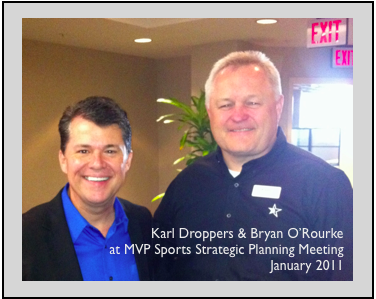
Karl Droppers & The MVP Sports Clubs Team

I really enjoy sharing my views on the fitness industry and how organizations can adopt new thinking and disciplines to achieve success. Its rewarding and fun to work with leaders of fitness and wellness organizations; its what we at fitmarc and integerus do everyday. So I was thrilled this week when I got to see Karl Droppers, President at MVP Sports Clubs, in person, along with his entire team during their strategic meeting in Orlando. I shared views on where the fitness industry has come, where its going and how organizations can adapt to deal with the changes ahead. Karl reached out to me after attending my IHRSA webinar in 2010 on how the bricks and mortar fitness business is changing.

Karl is a great leader and it is refreshing to work with an experienced professional who is open minded and recognizes the degree of change that is happening in the industry. Because of his forward thinking, I think good things are in store for his organization.

MVP Sports Clubs is an interesting and successful operation with facilities in Orlando and Michigan. The Orlando facility where the strategic meeting occured, which is called RDV Sports, is a huge complex of 365,000 sq. ft. that includes multiple ice rinks. The facility is incredible.

I also got to catch up with long time friend and associate Benny Hardouin, who I knew from my association with Franco's Athletic Club. The team was enjoyable with many senior people and a nice group of fresh faces. My thanks go out to the team at MVP Sports. I enjoyed meeting all of you.

I'm curious; when was the last time your organization had a quality strategic meeting ? Have you benefited from some fresh thinking about the future and where you are or could be taking your fitness or wellness business ? Let me, Bryan O'Rourke, know what you think. Please share your views. Is it helpful to have an outside fresh perspective when you are planning for the future ? If so who would you look to for that guidance ?

Can Health Clubs Achieve Renewed Growth ? Yes - By Applying New Disciplines

I get to hear from a lot of leaders in the fitness industry and as a result I learn a lot. As we know, the health club industry saw tremendous growth for a number of years that slowed significantly as the result of the rapid surge in competition and a slowing economy. Now, with the economy rebounding what should we learn from the past as we proceed to the future ? This is a timely question and I have a view - the health club industry needs to approach new opportunities with new disciplines.


Its time to rethink how we approach new business development in general as opposed to just picking up where we left off during the last boom.  Here's how. Professor Rita McGrath, in the clip below, outlines key disciplines essential to what she terms discovery driven growth. Central to her message is that leaders and managers should recognize the higher level of uncertainty that exists in business today and adapt their growth process accordingly. Rita is right, and the health club industry should heed her warning. As Rita explains, companies must apply new approaches. Could this be relevant for club operators ? I think so and her views are timely.

Watch the video below, share your thoughts and tell me Bryan O'Rourke: how can the health club industry best achieve new growth? Do you think Rita McGrath is correct ? Is the barrier to growth in the heallth club business more a function of how we approach growth as anything else ? Must health clubs change their assumptions about club operations, the marketplace and growth strategies to achieve better results and how ? I am looking forward to hearing your thoughts.