Where is Twitter Headed ?

At “Chirp”, Twitter’s developer conference, the company unveiled promoted tweets, new mobile apps, an enhanced geo-tagging feature, a link-shortening function, live search and the sale of its archives to the Library of Congress. That is a lot to talk about at a single event, but its not surprising given what's been going on with Twitter for the past year.

Augie Ray from Forrester shared this view, "Twitter's been under a lot of pressure to be a more transparent business. Now the company has come to a point in its maturity where it's starting to operate much more as a business and less as a startup."

The announced changes are not without skeptics. Some feel the promoted tweets are intrusive and third-party app developers are concerned Twitter is trying to put them out of business. But Twitter has also been criticized for taking too long to unveil its long term plans. Developers were unclear about where they should invest their efforts.

Here is an overview of the latest changes coming to Twitter with much of it based on David Goldman’s recent CNNMoney.com article “Twitter grows up: Take a peek inside”: Thanks David. Also, watch the video about foursquare's reaction to Twitter.

Promoted tweets: By far the most significant announcement. When users search with select keywords, a tweet from a company that bought those keywords will appear at the top of the feed. Companies that currently feature ads on the site include Best Buy (BBY, Fortune 500), Starbucks (SBUX, Fortune 500) and Sony Pictures.

Though the current model is still in the experimental phase, the company is hoping to succeed by making the promotional advertising more closely reflect individual users' interests.

Ensuring Twitter remains consumer-driven and not overly corporate is key to its survival, said Bob Pearson, president of the Social Media Business Council. "The reason Twitter is successful is because it has allowed customers to find what's relevant to them," said Pearson. "If Twitter starts deciding for people what's important, that's not going to work."

Mobile apps: Twitter recently unveiled an official BlackBerry app, and bought the most popular Twitter app for Apple's (AAPL, Fortune 500) iPhone, called Tweetie. The company also plans to soon release an official Android app.

Twitter had previously relied on third-party developers to allow mobile users to access their Twitter accounts on their phones. Apps like Twidroid, Tweetie and UberTwitter were some of the most popular, but there were dozens of others.

Twitter nabs top app maker

It comes as little surprise that having no official mobile app was a barrier to new customers. When people searched for a Twitter app, many were confused about which one to use. While an official Twitter app hasn't made third-party developers too happy, Twitter made it clear that those developers are still hugely important. "It's not a coup against developers," said Ray of Forrester. "It's absolutely clear that Twitter is very committed to improving its platform for the development community."

Geo-tagging: Another big announcement was the unveiling of a "Places" function that would better allow users to see where tweets were coming from. Twitter will keep a database of restaurants, bars, parks, stations and other public arenas. Developers use that data to create tools like check-in, similar to other location-based services like Foursquare and Gowalla. Though some believe this poses a direct challenge to some of the more entrenched location-based services, Twitter argues that the new functionality is more of a complementary service.

It's more likely that Twitter would use the information to provide more relevant tweets about a specific area or place than hand out virtual points, badges or rewards like Foursquare's check-in.

Link-shortening: Since Twitter only allows users to post 140-character messages, URLs can take up a large chunk of the space for tweets. Services like bit.ly have become popular ways to shorten links to post in tweets. But using those services is cumbersome because users have to go outside Twitter's world to create those links.

Lawbreakers foiled by Facebook

Like with geo-tagging and mobile apps, the announcement made some developers nervous about the viability of their link-shortening services. But the barriers to creating link-shortening were so small (just register a two-character ending) that the business model of those services was questionable anyhow.

Archives: Twitter sold the rights to its archives to the Library of Congress, making them searchable on Google (GOOG, Fortune 500). All public tweets, dating back to the very first one on March 21, 2006, are now hosted in the government's Library of Congress. Users can access the archive by selecting the "Updates" option on Google's search page. The new feature adds a timeline at the top of the results page that shows the relative volume of tweets about that topic.

Live search: Lastly, live Twitter feeds began appearing in Bing search results pages this week. Twitter feeds have already been showing up in Google's search results for awhile, which served as the first source of revenue for the young company.
How is Twitter Impacting Travel ?

Twitter is a great tool and resource for some travelers who use it for everything from checking itineraries to ordering a meal. Interestingly some 60% of people who purchase travel online are social media users and more and more savy travel companies are proactively offering customer support for travel matters via twitter. JetBlue serves as an excellent example of how to do Twitter well.

SmartMoney reporter Kristen Bellstrom talks about creative ways travelers and companies are using it to connect. Watch !

What's Not Included in the iPhone 4 OS ?

Nicole Lee, associate editor for CNET, recently shared some interesting observations in an article today about what was NOT included in the recent iPhone 4 OS upgrade. Here are her thoughts:

  • Mass storage mode: We would've liked to see an easier way to just drag and drop files from our computer to the iPhone without having to go through a third-party app.
  • Tethering with AT&T: Yes, we know this is already possible with the current OS, but AT&T in the U.S. have not gotten onboard with it yet (tethering is currently available in other countries like Canada and the U.K.). We were hoping we would hear more about it at the event, but no dice there.
  • Audio profiles: It would have been nice if the iPhone had different audio profiles for different environments that you could easily switch between.
  • Flash support in Safari: Yeah, this was a pie-in-the-sky wish, but we know a lot of you out there wanted it.
  • FM radio: Another one that was highly unlikely, but again, we know there are some who want it.
  • Wi-Fi syncing: We would've really liked it if we could sync or back up our information on the iPhone over Wi-Fi instead of having to plug in our USB cable.
  • Built-in photo editing: We know you can get third-party photo editors on the iPhone but it would be nice to have a built-in one as well.
  • Printer support: This is a little more relevant to the iPad, but we also wished iPhone OS 4 would provide some printer driver support, which would be very helpful for printing out documents and notes.
  • Multiple notification bar: On Android, there is a handy pull down area where you can see all of your recent notifications, like for your new messages or new voicemails. It would be nice to see that on the iPhone as well.

So do you think that her expectations were a bit too high for this recent release ?

What Will iPhones OS 4 Be Like ?

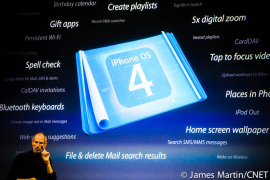
iPhone's new operating system details were released in a press event at Apple's headquarters today. The OS 4, will be released to developers this week and to users in the summer. It will provide access to calendar, photo library, still image and video data, and includes abilities to help apps run faster. In addition the new OS will support multitasking of apps. It will be interesting to see when the continual upgrades stall out and when a new iPhone hardware device is planned to be offered.

"We weren't the first to this party but we're going to be the best, just like cut and paste," said Apple CEO Steve Jobs, alluding  that cut-and-paste hadn't been available until a year after the first iPhone launched.

Jobs went on to say, "It's really easy to implement multitasking in a way that drains battery life. If you don't do it just right your phone's going to feel sluggish and your battery life is going to go way down. We've figured out how to implement multitasking of third-party apps and avoid those things."

The new iPhone OS will allow users to press the home button twice to see a menu of  active apps. Tapping one app takes you directly into that app. Apps can remain running in the background. Some of the benefits to this are, for example, that you can keep listening to music in Pandora while doing other things on the phone. The multitasking enables push notifications to alert users to an incoming Skype call. "It was really simple to implement. Just a dozen lines of code," said Skype's head of product development David Ponsford.

Another example of the new OS capabilities are letting you know when an app running in the background has requested your location from the device's GPS. This to address privacy and security issues.

The announcement comes a week after Apple's launch of iPad. Apple has sold 450,000 iPads to date, and users have downloaded more than 1 million iPad applications and over 650,000 digital books from the iBooks store. The company has sold more than 50 million iPhones and 35 million iPod Touches.

TheiPhone, iPod Touch, and iPad all run iPhone OS 3.0. The current OS has been criticized for lacking multitasking support for full multitasking. The OS also restricts add-on software to apps available through Apple's App Store.

The App Store currently contains 185,000 apps, Jobs said, adding than users have downloaded more than 4 billion apps from it to date. About 3,500 of those apps are optimized for the iPad.

Additional features planned for iPhone OS 4 include a 5x digital zoom camera feature, and tap to focus in video.


The Big Short - A Human Story

Living in New Orleans, it is gratifying to see one of its native sons do well. With the Saints winning the Super Bowl this year behind quarterback Drew Brees and now author Michael Lewis sharing his recent book, The Big Short, Inside the Doomsday Machine, an expose on the recent global financial crisis, there is a lot to be proud of in the "Big Easy".

In the case of Lewis, once you start you can't put down the "Big Short". More than that, while reading it, you can't imagine the story could be true; but it is. More than just a recount of facts about the financial crisis and what happened during the past decade, the book is a deeply human story about a small group of people and what they faced with clear minds amid a group of lunatics.

Read Felix Salmon's review on the Barnes and Noble site, here is an exerpt:

The result is that rarest of beasts in a world drowning in financial-crisis books: a new book which actually breaks news. For instance, Lewis uncovers what could possibly be the single greatest trade that any Wall Street banker ever made: in December 2006 and January 2007, Deutsche's Greg Lippmann paid an insurance premium of 0.28 percentage points to take out insurance on $4 billion of triple-A-rated bonds from Morgan Stanley's Howie Hubler. Less than a year later, that $11 million bet paid off to the tune of a whopping $3.7 billion. I'll save you the math: that's an annual return of more than 33,000%. There's lots more where that came from: this is an assiduously-reported and beautifully-written book. There aren't many reasons to be happy about the global financial crisis, but here's one: that it brought Michael Lewis back to his roots, to produce what is probably the single best piece of financial journalism ever written.

The story illustrates how institutions run by experienced people with a lot of knowledge can fail, quickly and dramatically. What happened in the financial markets can and will increasingly occur in many industries, as leadership becomes disconnected from the day to day realities being impacted by rapid advancements and change.

Watch the recent interview on Charlie Rose where Lewis shares more details and views. Get the book and remember that when everyone thinks they know the facts sometimes they don't.