Facebook Exceeds 300 Million - What Does It Mean ?

Facebook's CEO Mark Zuckerberg announced Tuesday that its online community crossed the 300 million user threshold, equaling the approximate size of the US population. About 70 percent of Facebook's users are outside the U.S., according to statistics posted by the company. Facebook says its fastest-growing demographic is people older than 35.

Facebook's growth reflects a tipping point for web 2.0 tools and its implications are far reaching for organizations, as consumer driven platforms will increasingly shape our world. With integrated voice chat coming soon to the platform, even more rapid evolution is inevitable. In Fortune's recent interview, CEO Sheryl Sandberg, reveals the rise of advertising revenues and users using the Facebook tool. She points out that you are seeing the beginning of what advertising is becoming - "part of the user experience".

One cannot underestimated the implications of Web 2.0 tools, which Facebook is. These tools and their users will redefine the constructs of markets and fuel business innovation opportunities. Truth is their adoption is just beginning and the tools will evolve rapidly with other even more powerful platforms like WAVE coming soon.

Three key points for organization's to keep in mind when employing these tools were brought to light in a recent article by Udayan Banerjee, The 3 Faces of Web 2.0, and are outlined below. When exploring Web 2.0 potential, its important to keep these points in mind.

1. Remember You Are Interacting with an Enlightened Consumer

“…the new consumer has grown up with brand new perspectives and redefined the interplay of communications, relationships, brands, technology and media.” – from Five Rules to Engaging a New Breed of Consumer

2. Adopting An Open Collaboration Platform Requires New Disciplines

“…make the corporate intranet into constantly changing structure built by distributed, autonomous peers – a collaborative platform that reflects the way work really gets done.” – from Enterprise 2.0: Dawn of Emergent Collaboration

3. Monetizing the Collective Intelligence of Users

“…collective Intelligence draws on this to enhance the social pool of existing knowledge.” – from Collective Intelligence page of Wikipedia
Socialnomics - A Business Revolution

Social media is not a fad, its a new way of interaction that is diminishing traditional media. By next year, generation Y will outpopulate the Baby Boomer generation and 96% of Y's are involved in social networks. If Facebook were a country it would be 4th largest in the world. 80% of companies are now using Linkedin to find employees and the fastest growing segement on Facebook are 55-65 year old females. 80% of tweets are made via mobile devices and therefore word of mouth has become world of mouth with only 14% trusting advertisements as a source of reliable information; afterall there are better sources via new technologies. Find out more in this incredible video on socialnomics.

The Economic Implications of the US China Relationship

As pundits continue to debate wether the US economy is emerging from recession, most are missing more important fundamental economic issues. Newsweek's recent article by Niall Ferguson, "Chimerica is Headed for Divorce", raises more relevant questions and serves as an interesting reflection on the consumer - producer relationship that has emerged between the US and China. Ferguson, the Harvard professor and author of The Ascent of Money , a book and PBS series, opines:

It ' s a bit like one of those marriages between a compulsive saver and a chronic spender. Such partnerships can work for a certain period of time, but eventually the penny-pincher gets disillusioned with the spendthrift. Every time Chinese officials express concern about U.S. fiscal or monetary policy, it reminds me of one of those domestic tiffs in which the saver says to the spender: "You maxed out on the credit cards once too often, honey."

Let's look at the numbers. China's holdings of U.S. Treasuries rose to $801.5 billion in May, an increase of 5 percent from $763.5 billion in April. Call it $40 billion a month. And let's imagine the Chinese do that every month through this fiscal year. That would be a credit line to the U.S. government of $480 billion. Given that the total deficit is forecast to be about $2 trillion, that means the Chinese may finance less than a quarter of -total federal-government borrowing—whereas a few years ago they were financing virtually the whole deficit.

Clearly the financing of US spending by the Chinese will be ending; its unsustainable and increasingly not in the best interest of the Chinese.  Furthermore, the possibility of the US garnering political will to tackle its fiscal indulgences is unrealistic. What are the implications? In the long run the rise and fall of empires follows the rise and fall of their economies. Watch Niall below describe some of the implications of these macro trends as we enter a new age of geopolitical considerations. No reserve currency last forever as this historian points out and the implications for declines in US standards of living among other important considerations are worth careful thought. Long run, interest rates will rise, purchasing power will decline and inflation will emerge to resolve the disequilibrium that has been existing for some time.


Apple - Understanding the Business You Are In

A recent article in PC Mag by Dan Costa pointed out something pretty interesting about Apple:

 Apple doesn't want to attract new customers—it mostly wants to keep its existing customers happy. Now, you might think that Mac people are so self-satisfied they don't need any help being happy. And you would probably be right. Still, these customers have proven they are willing to pay a premium for a product that is more commodified every day. In fact, Apple has a stunning 91 percent of the market for PCs that cost more than $1,000. Clearly, these are customers Apple wants to keep.

Costa points out that just 4.86 percent of worldwide Internet traffic comes from systems running the Mac OS. Even if you throw in iPhone users, the number barely passes 5 percent. Hardly a mass phenomenon. And thats a good thing indeed. You see by staying small Apple can be more innovative and flexible.

Apple is a great hedgehog organization, ala Collin's book. They understand the business they are in and act accordingly. Apple is committed to bringing the best personal computing experience to students, educators, creative professionals and consumers around the world through its innovative hardware, software and Internet offerings. That's its mission. The business understands its focus - Great businesses know its all about the consumer and the product. See an interview of Jobs as he talks about Apple.


Collins - How the Mighty Fall

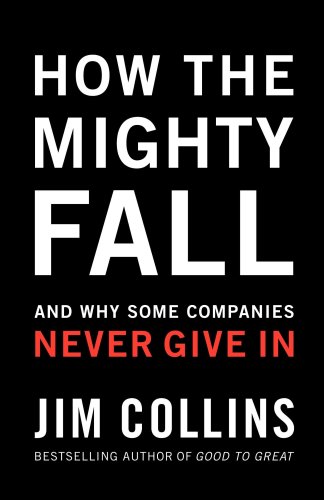
Jim Collin's new book "How the Mighty Fall and Why Some Companies Never Give In" asks, "How do great companies fall? Can the decline be detected and avoided? How far can a company fall before doom becomes inevitable and unshakable? How can businesses reverse course?" Well his answers are straight forward and insightful, as so often Collins is.

Collins confronts these questions, offering hope that leaders can learn how to stave off decline and, if they find themselves falling, reverse their course. His research project requied more than four years and uncovered five stages of decline:

Stage 1: Hubris Born of Success

Stage 2: Undisciplined Pursuit of More

Stage 3: Denial of Risk and Peril

Stage 4: Grasping for Salvation

Stage 5: Capitulation to Irrelevance or Death

Decline, Collins concludes, is largely self-inflicted, and the path to recovery lies largely in each companies own hands. We are not controlled by circumstances, history, or defeats along the way.

What is most notable about the book is the meaning of the tag line: "And Why Some Companies Never Give In". For many never giving in means holding on to the status quo. Instead Collins urges leadership to be willing to kill failed business ideas even shuttering long time big operations; to evolve into entirely different activities a part from present operations; to be willing to embrace loss and temporarily lose freedoms; to be willing to form alliances with former adversaries. “Never give in” is not continuing the same things. It means identifying that success is falling down and getting up one more time without end. Businesses must be willing to change in a disciplined fashion in order to survive, and there are many examples in this excellent book.

Check out Collin's video below as he outlines the five stages to decline identified in the book.