Nutrition & Our Obese World - The McRib

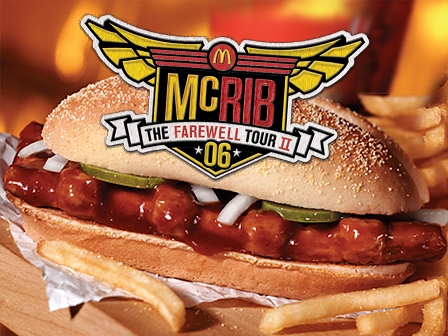
I don't know about you, but I've had about enough of McDonald's McRib Sandwich commercials - You know the one that shows a young man and a young woman appearing as though they'll be engaging in a lip lock that turns out to be their each biting into this awful sandwich all while hearing Matt White's song "Love". Are you kidding me ?

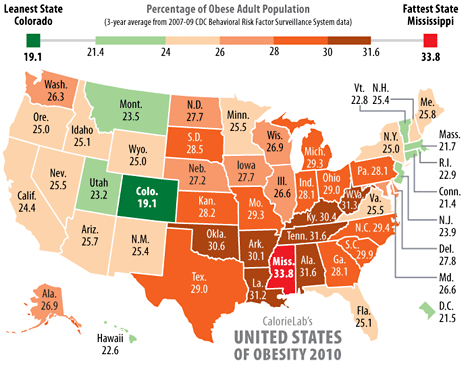
Having worked for years in the fast food industry while watching rates of obesity soar, when I see the amount of commerical promotion around a product like the McRib, given its ingredients, it makes me sad. Recently a new Harvard study showed that obesity rates will not level off until 2050 and people actually wonder why. Below are the nutritional facts and ingredients for McRib as well as rising obesity rates for the U.S. I didn't even post cancer rates, but I am certain there is some connection between the fumaric acids, fungal protease and ammonium chloride (yes its in there) among other lucious ingredients, in the wonderful McRib. Would so many people "Love" it if they only read the ingredients ?

McRib Nutritional Info: 490 calories, 220 calories from fat, 25 g fat, 8 g saturated fat, 75 mg cholesterol, 1040 mb sodium, 44 g carbohydrates, 2 g fiber, 24 g protein, 11 g sugars.

McRib Ingredients McRib Patty: Boneless pork (Pork, water, salt, dextrose, citric acid, BHA, TBHQ).
McRib Bun: Flour (wheat flour bleached and enriched with thiamine, riboflavin, niacin, iron, folic acid, malted barley flour), water, high fructose corn syrup, yeast, vegetable oil (partially hydrogenated soybean oil, cottonseed oil). Contains 2 percent or less of dextrose, fumaric acid, calcium sulphate, salt, acetic acid, soy flour, monocalcium phosphate, ammonium sulphate, cornstarch, fungal protease, natural culture, ammonium chloride, ascorbic acid, azodicarbomide, mono- and diglycerides, propionic acid, phosphoric acid, corn flour, calcium peroxide, calcium propionate, dicetyl tartaric acid esters of mono- and diglycerides, ethoxylated mono- and diglycerides. McRib Sauce: Water, high fructose corn syrup, tomato paste, distilled vinegar, molasses, natural smoke flavor, modified food starch, salt, sugar, soybean oil, spices, onion*, mustard flour, garlic *, xanthan gum, caramel color, sodium benzoate (preservative), natural flavor (vegetable source), corn oil. *Dehydrated Pickle Slices Cucumbers, water, vinegar, salt, calcium chloride, alum, natural flavorings (vegetable source), polysorbate 80, turmeric (color).
What do you think about rates of obesity and our cultural obsession with food that is so bad for you ? Contact me Bryan O'Rourke and let me know your thoughts.


Education & Fitness Professionals - A Dilemma That Requires An Answer

I am reading The 2011 ACSM Fitness Trend Survey this morning, which identifies the top 20 fitness trends. Interestingly, for the past 3 years the number 1 trend in the survey is "educated and experienced fitness professionals". Dr. Walter Thompson, author of the article on the survey, makes 2 important observations about this trend:

"According to the AKA, the kinesiology major grew by more than 50% from 2003 - 2008....and means that kinesiology is the fastest growing major in the U.S., as the market for fitness professionals becomes even more crowded and more competitive, the need for regulation, wether from within the industry or from external sources, is growing."

Thompson also alludes to the work of the NSF in establishing standardized facility practices.

During the past few months I've had the pleasure, with my partner Robert Dyer, to visit with leaders in fitness education including people from ACE, IDEA, Fitpro and many others. We all discussed the need for education and standards. Of course we talk with our over 600 fitness facility customers routinely as well and as a result I wonder; How will fitness professionals be able to pay more money for education requirements when their wages are actually stagnant or falling? I know a lot of trainers and group instructors and its hard for them to survive in the industry. IHRSA openly lobbies to prevent government regulation of personal training primarily to prevent the cost of government standards being passed on to facility owners. They do this because its getting more challenging to make a buck in the health club business. Yet, many in the fitness industry agree that better education is necessary to promote and progress the business. But who is going to pay for all of this when health club dues have declined on an inflation adjusted basis ? Do we believe that more educated professionals will result in consumers agreeing to pay more for services ? This is the dilemma that requires an answer.

I think a key problem is the business model of how exercise expertise is delivered to customer members. The prevalent one on one, face to face, modality is inefficient and can be augmented and improved with technology and new delivery systems that will enable exercise professionals to reach more members more effectively.

What do you think ? Contact me Bryan O'Rourke, and share your views about the fitness industry and educational requirements for professionals. What should happen to improve the professional prospects for fitness professionals and why, given that it is the number 1 fitness trend in 2011 according to the ACSM survey.

The Fitness Industry's Digital Divide - Leadership Should Embrace The Future

I visited with a well respected health club owner and fitness industry leader recently.  During our meeting the person commented that IHRSA "wants to remain a bricks and mortar association"; this in response to my many calls for the extant fitness industry to open its eyes to the opportunity new business models and technologies will offer, enabling it to reach its promise.

In this person's defense, the facility orientation of the industry is not uncommon; I speak with many health club owners and leaders who share this view. Change is hard and I know of many good people with good intentions who work hard at IHRSA and in the fitness business in general to forward the cause of prevention and wellness. However, this "bricks and mortar" emphasis is the same view many leaders in other industries had, before the future happened to them - think clothing and entertainment to name a few. It is the reason, I worry, that some existing business models in fitness are going to have increasing difficulty surviving.

To illustrate my point, think of the retail industry by comparison. From 2000 until 2007, online retail sales grew at an annual 20% clip. From now until 2014 sales will grow at a slower 10% rate, still well exceeding the "bricks and mortar" counter part. However the important thing to note is that by 2014 53% OF ALL "RETAIL" SALES WILL BE DELIVERED VIA THE INTERNET according to Forrester Research. You see it isn't about bricks and mortar; its about delivering things customers need the way they want them and doing it in a sustainable fashion.

Reading the WSJ article today, on my IPad none the less, I came across Eileen Gunn's article titled, "A Personal Trainer in the Palm Of Your Hand." By my estimation, now over 3 million people in the U.S. alone are using mobile technologies to guide them as personal trainers could or used to. Similarly, consider the explosion of wellness platforms and devices that provide low cost means of enabling people to improve their health. Point is: there is a lot changing and the customer is at the center of it - not bricks and mortar.

As with all businesses, leaders need to open their eyes to what is happening and prepare by driving innovation and evangelizing the benefits of an unavoidable future. The fitness industry is no exception - less we fail to reach the promise of making a real impact on health via prevention.

What are your thoughts on the fitness industry ? Contact me, Bryan O'Rourke, or share your views here and tell me what you believe about the bricks and mortar, IHRSA and the orientation of the fitness industry.

Where Is Bally Total Fitness Headed ? CBI Offers Clues

I read with great interest Patricia Amend's cover article on Michael Sheehan and Bally Total Fitness included in the November 2010 edition of Club Business International. The title, "A 21st Century Brand" is interesting. Certain operational moves made at Bally Total Fitness speak volumes about an organization that, I have a hunch, has an understanding of where the fitness industry is headed. Although as Michael Sheehan himself points out, "We'd prefer to be judged on the basis of our progress...".

As you know I've been writing and speaking about what the future of the fitness industry holds and therefore I don't think it a coincidence that the new management team at Bally Total Fitness is made up of 1) a former CMO from United Airlines, 2) a former CFO of the web travel giant Orbitz and 3) the former head of HR from The Home Depot. Not one of their new "C" level executives has deep roots in fitness, with the exception of Michael Sheehan himself. I think there is a reason for that. Growing a national fitness brand and designing and executing new consumer centric models that leverage technology are but one, but a significant component, of what I think the future is about. These skills are uncommon in the extant fitness industry so one should be paying close attention to Bally given their personnel moves. We've seen bringing in industry outsiders fail before with other national brands, but time will tell.

What do you think about Bally Total Fitness ? With their under performing clubs shuttered, debt eliminated and a vibrant new management team, will they rise from the ashes of 2 bankruptcy filings ? Contact me, Bryan O'Rourke, or share your views here and tell me what you think about the CBI article. Kudos to Patricia for her great article.

The Health Club Consumer Market - Increasing Impact of Women

I've visited the consumer trend topic before as it pertains to the fitness industry and wellness space, but wanted to share further content about it. Watch video of Michael Silverstein's discussion around the consumer marketplace - particulary the influence of women as consumers. Michael describes some interesting drivers behind consumer behaviors that have big implications. His books, which he has co-authored, include Trading Up the New American Economy, Treasure Hunt - Inside the Mind of the New Consumer, and Women Want More - How to Capture Your Share of the World's Largest, Fastest Growing Market, among other work. Good reads, which I highly recommend, that touch upon important consumer concepts affecting all industries. Bi-furcation is an important concept you should understand and particularly the growing impact of women on the purchasing decisions.

Competitors in all businesses and in particular the fitness industry and wellness businesses, should have Michael's concepts at the center of their brand strategies. Watch it and tell me, Bryan O'Rourke, what do you think about Michael's concepts ? Are they at the center of your brand strategies ?