Intelligently Using Email - PS Connect & Gmail Contextual Gadgets

Last night my son brought to my attention a post by Dong Chen, of the Gmail Contextual Gadgets team.

At Campfire One it was recently announced that Gmail contextual gadgets will be released as a new extension point for developers. These gadgets can intelligently draw information from the web and let users perform relevant actions based on the content of an email message, all without leaving the Gmail inbox. For example, contextual gadgets currently available in Gmail can detect links in emails to show previews of documents, videos, photos, and more, right inside the messages.

For businesses, Gmail contextual gadgets can improve productivity by complementing email in a context-specific and actionable way. Appirio, a cloud solution provider, provided a demonstration of the potential of Gmail contextual gadgets and other experimental features
with their new product PS Connect:. Watch !

As Chen notes, "Soon we’ll be opening Gmail contextual gadgets as an extension for trusted testing by developers. If you have a good idea for this type of gadget today, please fill out this form. And for those of you who will be attending Google I/O in May, be sure to check out the session on building Gmail contextual gadgets."

The Era of Behavior

Tom Friedman's Op-Ed in the NYT's today was titled "A Question from Lydia". In it Tom addressed a question a 10 year old Greek girl wrote at the site of the Marfin Engatia Bank, which was firebombed a few weeks ago. The question was "In what kind of world will I grow up?". Tom answered, "that's a good question Lydia", and I agree. Good news is that world is changing to a place with great potential for not tolerating such bad behavior.

My writing proposes that 6 degrees of change are increasingly emerging as the result of the revolution created by technology, global ism and demographic shifts:

1. Transparency modality becomes essential;

2. Traditional institutions vanish;

3. Orchestration strategy dominates;

4. Participation explodes;

5. Wealth increasingly is redistributed;and

6. Human conciousness profoundly evolves.

The increasing adoption of transparency as a requirement for doing things cannot be ignored or discounted. This will be driven by hyper-connectivity and a world where people's behaviors will not be able to be hidden.

This view is shared by thought leader Dov Seidman, and articulated in his recent book: How, Why How We Do Anything Means Evertyhing . As Tom mentions in his NYT Op-Ed:

When Greeks binge and rack up billions of euros of debt, Germans have to dig into their mattresses and bail them out because they are all connected in the European Union. Lost in Athens, felt in Berlin. Lost on Wall Street, felt in Iceland. Yes, such linkages have been around for years. But today so many more of us are just so much more deeply intertwined with each other and with the natural world. That is why Dov Seidman, the C.E.O. of LRN, which helps companies build ethical cultures, and author of the book “How,” argues that we are now in the “Era of Behavior.”

Of course, behavior always mattered. But today, notes Seidman, how each of us behaves, consumes, does business, builds or doesn’t build trust with others matters more than ever. Because each of us, each of our banks, each of our companies, now has the power to impact, for good or ill, so many more people’s lives through so many more channels — from day-trading to mortgage-lending to Twitter to Internet-enabled terrorism.

Watch Dov's lecture below. Dov calls this , "The Era of Behavior". After reviewing the book, I recommend it highly thanks to Tom's editorial.

Surging Mobility - Home Phone Lines Disappearing

In yet another example of how industries are going throug rapid change, it was recently reported that twenty-five percent of U.S. households rely exclusively on mobile devices for communication, having cut their traditional land lines. According to the latest statistics from the Center for Disease Control and Prevention (CDC), the number of wireless-only households continues to increase. In the first half of 2009, around 22% of all households did not have a landline.  It is worth pointing out that 15% of households that have a landline say they now receive almost all of their calls on their mobile phone. Therefore it is likely that the percentage using mobile exclusively will continue to increase and probably at a more rapid pace.

Younger adults under 35 are most likely to have cut their landlines, but the number of wireless-only households increased among all age groups. Half of all adults aged 25 to 29 now live in households that are wireless-only, but around 5% of adults over 65 don't use landlines. The full report from the CDC is here (PDF).

What Does This Mean?

This is an interesting trend because most mobile application development has been focused on the traveler. This will start to shift as users of mobile devices will look for applications that are usable at home or in the office.  For example, the market for in-home apps that control appliances will likely surge in the coming years. It also means that telecommunication issues around wireless and Internet, particularly as it pertains to maintaining a free Internet, will garner more and more attention.

The Euro and World Economy - A Revolution is Underway

I've been writing that we are in the midst of a revolution driven by radical advances in technology, globalism and shifting demographics; the result of which is a time of rapid revolutionary change impacting all institutions and individuals. In the end many postive changes for humanity will result, but the process of going thru change will entail some great pain - partiularly as it pertains to large institutions like governments.

The Economist's, recent editorial Coming to a City Near You, reflects on the crisis in Greece that included chaos in the streets and the death of 3 people. Here's what it said:

IF THERE was ever a week to be depressed about the euro, this was it. After an age of dithering, Europe’s politicians cobble together a colossal rescue package for Greece, worth some €110 billion ($145 billion), nearly three times the level discussed only three weeks ago—and behold the results: carnage on the streets of Athens, where three people lost their lives, and no respite in the markets.

The idea that governments solve problems has become so mainstream yet is divorced from the reality of what they've been up to over the past few decades - spending more than they have to spend and borrowing the rest. More importantly these institutions and their populist participants have not been adequately changing how things are done or facing key problems. As a result the opportunity for needed improvements have not materialized. Read this excerpt from the Economist's recent article, The Sad End of the Party:

At the same time Greece’s worst habits—the plundering of state coffers, the hiring of cronies, the abuse of public office, impunity for the powerful—were multiplying. A handful of Cassandras said it would all end in tears but, while the party lasted, nobody listened.

This quote could be easily applied to the US or most of the other significant nations today. Putting aside the unique aspects of Greece's culture which includes the idea of a manipulating “foreign finger” as a recurring motif, what we are truly seeing in the EU, is that which we will see across many economies in the coming months and years. A reconciliation for irresponsible behaviors that created imbalances which will be addressed by the markets. Increasingly people will question the purpose of the government's they have in place and what they've been up to. Look for much more upheavel in the months and years ahead around this. Watch the video below.

The IPad Books & Newspapers - Gerson is Right

If you read my posts you know how often I reflect on how technology is changing the world and doing it really really fast. A lot faster than folks realize. This is going to revolutionize a lot of industries and people's lives. Its sneaking up on us and for many, one day they are going to turn around and ask, "what happened?"

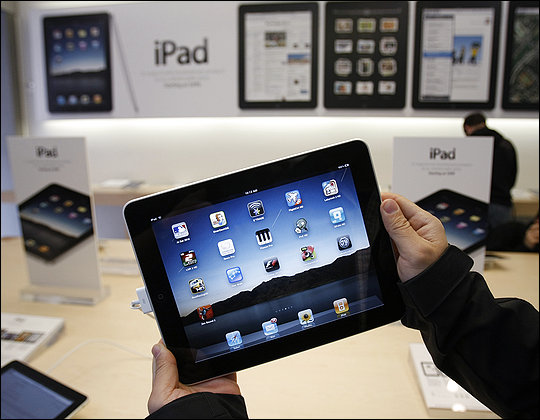
Michael Gerson, Op-Ed Columnist at the Washington Post, recently penned an editorial, The 64 Gigabyte Shape of the Future. In it he illustrates this point.

"Media mogul Rupert Murdoch recently observed, "I got a glimpse of the future last weekend with the Apple iPad. It is a wonderful thing. If you have less newspapers and more of these . . . it may well be the saving of the newspaper industry." "

When Op-Ed columnists begin to realize the potential that rapidly evolving technologies offer their dying newspaper business models, there is hope. When the nostalgia gives way to the practical benefits of change, we are well on our way to a brighter future and people like Mr. Gerson won't be the ones scratching their heads when it arrives. As Michael observes in the article :

So: We know that even bibliophiles like me will purchase books that arrive via the Internet because it represents a quantum leap in convenience. We know that people will consume both good and unreliable news on the Internet when it comes free. Because of the iPad (and its eventual competitors), we will be able to test whether people will pay for excellent news content delivered on a platform that multiplies its usefulness and enjoyment.

Those of us nostalgic for the book-based culture also will be nostalgic for ink on our fingers, the crinkle of thin pages, paperboys and papergirls and stopping the presses. But there really is no competition. Tablet computing makes a user feel like a maestro or a magician, summoning worlds with a touch. Prospero throws his books into the sea to abandon magic. A million people have done the same to embrace a new kind of magic.