The IPad Books & Newspapers - Gerson is Right

If you read my posts you know how often I reflect on how technology is changing the world and doing it really really fast. A lot faster than folks realize. This is going to revolutionize a lot of industries and people's lives. Its sneaking up on us and for many, one day they are going to turn around and ask, "what happened?"

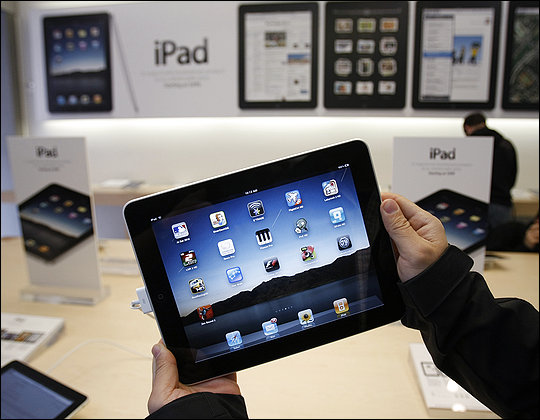
Michael Gerson, Op-Ed Columnist at the Washington Post, recently penned an editorial, The 64 Gigabyte Shape of the Future. In it he illustrates this point.

"Media mogul Rupert Murdoch recently observed, "I got a glimpse of the future last weekend with the Apple iPad. It is a wonderful thing. If you have less newspapers and more of these . . . it may well be the saving of the newspaper industry." "

When Op-Ed columnists begin to realize the potential that rapidly evolving technologies offer their dying newspaper business models, there is hope. When the nostalgia gives way to the practical benefits of change, we are well on our way to a brighter future and people like Mr. Gerson won't be the ones scratching their heads when it arrives. As Michael observes in the article :

So: We know that even bibliophiles like me will purchase books that arrive via the Internet because it represents a quantum leap in convenience. We know that people will consume both good and unreliable news on the Internet when it comes free. Because of the iPad (and its eventual competitors), we will be able to test whether people will pay for excellent news content delivered on a platform that multiplies its usefulness and enjoyment.

Those of us nostalgic for the book-based culture also will be nostalgic for ink on our fingers, the crinkle of thin pages, paperboys and papergirls and stopping the presses. But there really is no competition. Tablet computing makes a user feel like a maestro or a magician, summoning worlds with a touch. Prospero throws his books into the sea to abandon magic. A million people have done the same to embrace a new kind of magic.

Group Video Coming to Skype

Mainstream telepresence is something I've been writing about for a while. Amazingly while it has grown significantly, still many businesses don't utilize the tool for communications internally or with customers. That will surely change as travel costs continue to rise and the technology goes more mainstream.

In keeping with the continual evolution of video conference calling, Geoff Fowler of the WSJ just reported that Skype unveiled a new group video chat service and subscription plans, as it builds out its strategy of offering a free service that makes money by charging for extras.

As Mr. Fowler wrote, Skype will next week launch a free trial of an upgrade to its PC-based calling software that lets up to five people make a video call at the same time. The trial will be free, but the company will begin charging for the group feature — one of its users' biggest requests — later in the summer. Video calling is the Internet company's fastest-growing service, it said, accounting for one third of all calls.

Skype also unveiled new paid subscription plans that allow people to make calls to cellphones and landlines in 170 countries. That feature particularly targets those who make calls into developing nations, where the cost of making calls through traditional carriers can still be quite high, said Neil Stevens, general manager of Skype's consumer business segment.

"A very large percentage of our revenue and growth can come from having products to call cost-effectively to the long tail" of cellphones in the developing world, he said.

Skype, which has helped pioneer Internet calls, has offered the service free for years and says it now has more than 560 million users world-wide.

EBay Inc. last year sold controlling interest in Skype to a group of investors that includes its founders.

Mr. Stevens said the company also plans to focus on getting Skype on more devices beyond computers, such as cellphones. Skype has been installed on 12 million of Apple Inc.'s iPhone and iPod Touch devices, and the company will in the months ahead come out with a new version of its software that enables people to make free Skype calls over the 3G cellular data plans used by iPhones. Currently, it works only on iPhones through Wi-Fi data connections.

Mr. Stevens said Skype is also working on an app for Apple's iPad for release over the summer. When Apple releases a new version of its mobile operating system in the coming weeks, Skype will also be able to run as a background app, allowing people to receive calls even as they do other things.

Mr. Stevens said Skype would like to be able to also provide video calling on smart phones, but has a number of technological hurdles to clear first, such as the high bandwidth required by video calls. Apple's mobile software currently doesn't allow developers to access a device's built-in camera, he noted.

Skype is also experimenting with advertising for revenue. In Europe, it has tried a click-to-call service with a directories company, where an advertiser pays for a call that a potential customer can make for free.


Small Companies Are NOT Using Technology to Drive Business

According to a recent Citibank survey, most small businesses do not utilize affordable technologies to drive their business.

37 Percent Not Using Web site to Expand Business; 84 Percent Not Selling Products, Services Online; 62 Percent Not Using Email for Marketing

63 Percent Say Word of Mouth Most Effective Way to Market their Business and Find New Customers, Yet 81 Percent Don’t Use Social Media

Despite the ubiquitous and relentless buzz around social media, most businesses today aren't leveraging basic online tools readily available to them to help grow their businesses, according to the latest small business survey by Citibank.

“This may be because the online world does not fit their business model or other factors such as inexperience with technology or lack of time to effectively enter these marketing channels. It’s encouraging, however, to see that many intend to utilize more of these tools in the next 12 months.”

According to the survey of 552 small business executives across the United States, in the last year 37 percent of small businesses have not used a Web site for marketing or expanding their business and 84 percent have not used ecommerce to sell their products or services. Additionally, 62 percent aren’t using basic email for marketing their business. Yet among those businesses that do have a Web site, 74 percent say their site has been effective at generating more business.

“Many small businesses today have yet to really harness the marketing and communication power that online tools can provide them,” said Raj Seshadri, the head of Small Business Banking at Citibank. “Our survey reveals a huge opportunity for many businesses to begin using some of the basic online tools, such as email marketing, to drive their sales.”

When it comes to more advanced methods of online marketing, and increasing reach and influence, the survey’s findings were similar: Sixty-five percent of small businesses are not placing online ads to expand their business and 67 percent have not used search engine optimization.

The survey also uncovered a disconnect regarding the importance placed on word-of-mouth marketing by small businesses. Sixty-three percent of respondents say word-of-mouth marketing is the most effective way to market their business and find new customers. Yet this doesn’t translate into online behavior, showing that many do not view social media as a word-of-mouth channel; 81 percent say they have not used social media sites such as Facebook, LinkedIn or Twitter. Among those not using social media sites, 47 percent don’t believe these sites are of value to their business while another 21 percent believe these sites are more for personal than business use; 18 percent say they don’t know enough about how to use the sites.

At the same time, many small businesses say they plan more online activity in the next 12 months. Among the findings:

  • 72 percent say they are likely to use a Web site for marketing or expanding their business in the next 12 months - up 14% from those who do today.
  • 24 percent will likely use ecommerce to sell their products or services online over the next 12 months – up 50% from those who do today.
  • 30 percent say they intend to use social networking sites such as Facebook, LinkedIn or Twitter for marketing or expanding their business – up 58% from those who do today.

“This survey shows that many small businesses have yet to add new tools to traditional marketing methods that they have found effective in the past,” said Seshadri. “This may be because the online world does not fit their business model or other factors such as inexperience with technology or lack of time to effectively enter these marketing channels. It’s encouraging, however, to see that many intend to utilize more of these tools in the next 12 months.”

Small Business is 70% of the Global Economy

As Ian Pennell, Cisco's Co-Chair of its small business counsel attests, smaller companies are the heart beat of the global economy. Watch his video on the Cisco intiative are solutions designed for small companies and organizations.


What Does Technology Want ?

Kevin Kelly, co-founder of Wired Magazine, is releasing a new book Viking/Penguin publishers call "What Technology Wants," this fall. He is a well thought of speaker and writer and I enjoyed watching a recent interview on his lecture at TEDxAmsterdam named after the upcoming book "What Technology Wants". The topic is timely given the rapid advancement of technology and its impact on people and organizations.

Watch the video for a better understanding of where technology is headed and what it truly is - a cosmic force that preceeded humans - a force of self organization that we are riding into the future. His full lecture and slides are below.


TEDxAmsterdam: Kevin Kelly from TEDxAmsterdam on Vimeo.


The Quantified Self - Technology Implications in Everyday Life

Gary Wolf, writes about science and social issues for Wired, where he is a contributing editor. Gary is also working on a project with Kevin Kelly and a book termed, "The Quantified Self". He recently wrote an interesting article for NYT Magazine, The Data Driven Life which reflects on the surge of new devices that track everything and demonstrates his keen interest in the quantified self concept. The advent of inexpensive technologies is creating new ways for people to think about how they live. As I have spoken about recently at the IHRSA show for the health and fitness industry this is a significant trend that is and will continue to have tremendous impact and implications. Here are some excerpts from Gary's recent article:

Millions of us track ourselves all the time. We step on a scale and record our weight. We balance a checkbook. We count calories. But when the familiar pen-and-paper methods of self-analysis are enhanced by sensors that monitor our behavior automatically, the process of self-tracking becomes both more alluring and more meaningful. Automated sensors do more than give us facts; they also remind us that our ordinary behavior contains obscure quantitative signals that can be used to inform our behavior, once we learn to read them. 

“The real expertise you need is signal processing and statistical analysis,” says James Park, the chief executive and co-founder of Fitbit, a company that makes a tracker released late last year. The Fitbit tracker is two inches long, half an inch wide and shaped like a thick paperclip. It tracks movement, and if you wear it in a little elastic wristband at night, it can also track your hours of sleep. (You are not completely still when sleeping. Your pattern of movement, however, can be correlated with sleeping and waking, just as the acceleration of a runner’s foot reveals speed.) Park and his partner, Eric Friedman, first showed their prototype at a San Francisco business conference in the summer of 2008. Five weeks later, Park and Friedman, who are both 33, had $2 million in venture capital, and they were flying back and forth to Singapore to arrange production. Last winter they shipped their first devices.

At nearly the same time, Philips, the consumer electronics company, began selling its own tiny accelerometer-based self-tracker, called DirectLife, which, like the Fitbit, is meant to be carried on the body at all times. Zeo, a company based in Newton, Mass., released a tracker contained in a small headband, which picks up electrical signals from the brain, and uses them to compile the kind of detailed record of light sleep, deep sleep and REM sleep that, until now, was available only if you spent the night in a sleep-research clinic. Lately I’ve been running into people who say they wear it every night. And Nike recently announced that its Nike+ system, one of the first personal speedometers, has been used by more than 2.5 million runners since its release in 2006.

Read the article and follow Gary and Kevin. They have a lot to say and share about what is happening with technology and its impact on our everyday lives and culture.